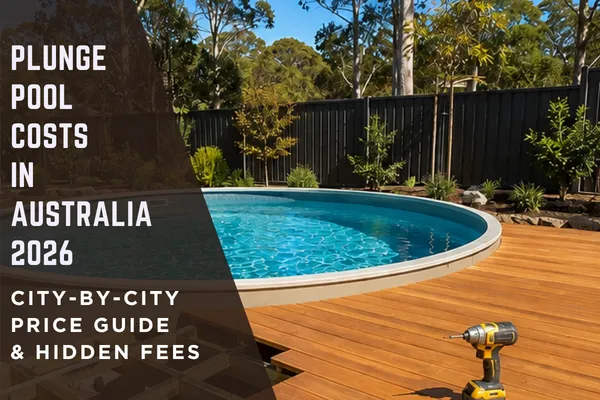
Plunge Pool Costs In Australia 2026: City-By-City Price Guide & Hidden Fees
Last updated: 13 October 2026. Prices current for summer 2026–27.
Pool quotes in Australia can climb fast. A concrete build can run well into five figures before anyone mentions fencing, and the extras often arrive after you've already said yes. So this guide does the sums upfront. It covers what an Aussie Plunge Pool™ costs in 2026, what you'll pay on top, and how those extras change from city to city.
We've updated every figure for 2026: current factory-direct prices for both ranges, local pool-fencing rates for eight cities, and the compliance costs that vary by state.
The bottom line: In 2026, an Aussie Plunge Pool™ starts at $4,550, plus delivery. Most buyers then budget for three main extras: a compliant pool fence, a power point for the pump, and a level base. On a typical above-ground install, the fence is the largest of these, and its cost depends mostly on your city and your choice of aluminium or glass.
How Much Does A Plunge Pool Cost In Australia In 2026?
A factory-direct poly plunge pool costs from $4,550 to $11,995 for the pool itself, depending on the range and size. Traditional concrete and fibreglass pools usually cost $35,000 to $150,000+, because the price includes excavation, steel, formwork, specialist crews and weeks of site time.
That gap is the main reason compact poly pools have taken off. An Aussie Plunge Pool™ arrives as one finished shell, rotomoulded in a single piece from UV-stabilised polyethylene. There's no concrete to cure, no tiling and no pool crew on site for weeks. As a result, most of your budget goes into the pool rather than labour.
2026 Aussie Plunge Pools Price List
Aussie Plunge Pool™ prices 2026 (skimmer box included with every model, fitted onsite)
Model | Size | Depth | Dry weight | Price |
|---|---|---|---|---|
5,000L Round | Ø 2,470mm | 1,300mm | ~125kg | $4,550 + delivery |
7,000L Round | Ø 2,900mm | 1,300mm | ~150kg | $5,950 + delivery |
10,000L Round | Ø 3,400mm | 1,300mm | ~190kg | $6,950 + delivery |
10,500L Deep Round | Ø 3,300mm | 1,500mm | ~190kg | $7,350 + delivery |
11,000L Infinity-8 | 5,000mm × 2,500mm | 1,300mm | ~300kg | From $9,950 (in-ground) / $11,995 (above-ground) + delivery |
Not sure which range suits you? Our Plunge Pool Size Guide compares every model's depth, footprint and use and helps you match a size to your yard.
What Else Do You Need To Budget For?
Beyond the pool and delivery, most installs come down to five cost items. Some are fixed, and others depend heavily on your site and your city.
Delivery. Delivery costs vary with distance and access from our Alstonville factory in the Northern Rivers of NSW, so contact the team with your postcode for a quote.
A level base.A compacted crusher-dust pad usually costs a few hundred dollars in materials, plus a day's plate compactor hire. A concrete slab costs more; concrete averages around $100 per square metre nationally, although small jobs often attract a minimum charge.
Power for the pump.Only a licensed electrician can install a new outdoor power point. Expect roughly $175–$500, plus around $650–$1,100 if your switchboard needs a new dedicated circuit.
Filtration.A pump and sand filter keep the water clear. The Aussie Plunge Pools Basic Pump + Sand Filter Kit costs $995, with free delivery when you buy it with your pool, so the matched fittings arrive in the same drop.
A compliant pool fence.Required for any pool that can hold more than 300mm of water, which includes every model in both ranges. This is usually the largest extra, so it gets its own section below.
If your site has no side access, you may also need a crane truck. A single lift often costs a few hundred dollars when you book it ahead. Our Site Preparation guide covers bases, access and delivery day in detail.
Plunge Pool Costs City By City
The pool price is the same Australia-wide. What changes between cities is delivery distance, local trade rates and state compliance rules. Pool fencing shows the biggest swing, so here are installed per-metre rates for October 2026, alongside the main approval and registration step in each state.
Pool fencing costs and approval steps by city, October 2026 (installed, per metre, GST included)
City | Aluminium pool fence (per m) | Frameless glass (per m) | Approval & registration |
|---|---|---|---|
Sydney | $115 to $400 | $345 to $920 | CDC or DA; free NSW Swimming Pool Register |
Newcastle | $95 to $330 | $285 to $760 | CDC or DA; free NSW Swimming Pool Register |
Brisbane | $100 to $350 | $300 to $800 | Building approval via certifier; free QBCC Pool Safety Register |
Gold Coast | $98 to $345 | $295 to $785 | Building approval via certifier; free QBCC Pool Safety Register |
Melbourne | $90 to $180 | $315 to $840 | Building permit; council registration (one-off fee, around $36 in 2025–26) plus barrier certificate lodgement |
Perth | $105 to $370 | $315 to $840 | Barrier inspected by local government at least every four years |
Adelaide | $92 to $320 | $275 to $735 | Check with your council |
Canberra | $110 to $385 | $330 to $880 | Check with the ACT building authority |
Fencing rates: What's The Damage? city cost guides, verified July–October 2026, GST included. Registration details: NSW Swimming Pool Register, QBCC, Victorian council fee schedules 2025–26. Rules change, so confirm with your council or certifier before you order.
What does that mean for a real install?
Here's a worked example for a 7,000L Aussie Plunge Pool™ installed above ground in Brisbane:
Pool: $5,950 + delivery
Basic Pump + Sand Filter Kit: $995 (delivered free with the pool)
Crusher-dust base: a few hundred dollars
Outdoor power point: $175–$500
Aluminium pool fence, around 16 metres to enclose a 4m × 4m pool area: $1,600–$5,600
That totals roughly $9,000–$13,600, plus pool delivery and any certifier fees. Swap the aluminium for frameless glass and the fence alone becomes $4,800–$12,800. In short, your fence choice can move the total more than your pool choice.
For state-specific rules, see our Australian Pool Regulations 101 guide and the Plunge Pools Sydney guide.
Why Does A Poly Plunge Pool Cost So Much Less Than Concrete?
A poly plunge pool costs less because it removes most of the labour. A concrete pool needs excavation, steel reinforcement, formwork, spraying and a cure of around 28 days. Fibreglass is faster, but large shells usually need a crane and significant digging.
An Aussie Plunge Pool™, by contrast, arrives finished. It weighs roughly 100kg to 300kg dry, depending on the model, so a few helpers can roll most shells into place on a trolley. Furthermore, you can install it above ground with no excavation at all.
No excavation for an above-ground install
No curing time- fill it as soon as it's positioned and plumbed
No specialist pool crew- many owners install it themselves
Portable- drain it and move it to your next home
Duraplas Industries, the family business behind Aussie Plunge Pools, has been rotomoulding polyethylene at its Alstonville factory since 1984. For the full material comparison, read Poly Vs Concrete Vs Fibreglass Plunge Pools.
Which Hidden Costs Catch Buyers Out?
The costs that surprise buyers are rarely about the pool. Instead, they come from the site and the rules around it.
1. Fencing. Every pool deeper than 300mm needs a compliant barrier. Budget for it from day one, not after delivery.
2. Approvals. In NSW, any pool holding more than 2,000 litres generally needs a CDC or DA. Queensland and Victoria also require approval before the pool is filled. Ask a certifier for a quote early.
3. Access. An unplanned crane on delivery day is one of the most avoidable extras. Measure your side access before you order.
4. Power. Older switchboards sometimes need a new circuit, which can double the electrician's bill.
5. Running costs. Power for the pump, sanitiser and water top-ups add a modest ongoing cost. See How Much Does A Plunge Pool Cost To Run In Australia? for the numbers.
How Can You Keep Your Plunge Pool Costs Down?
You can keep costs down by choosing an above-ground install, an aluminium fence and a DIY base. Together, those three choices make the biggest difference to the final figure.
Go above ground. No excavation and no retaining. You can always add decking or cladding later.
Choose aluminium over glass. Both meet the same Australian Standard. Glass is a design choice, not a safety upgrade.
Build the base yourself. A crusher-dust pad is a realistic weekend job. Our DIY vs Landscaper vs Installer guide compares the routes.
Order before the rush. Delivery slots and tradie calendars fill quickly heading into summer. Our winter buying guide explains why the cooler months suit installs.
Start with a smaller Plunge Pool. If depth isn't a priority, the 5,000L Aussie Plunge Pool™ is the lowest-cost way into real pool ownership at $4,550 plus delivery.
Frequently Asked Questions: Plunge Pool Costs In 2026
How much does a plunge pool cost in Australia in 2026?
An Aussie Plunge Pool™ starts at $4,550, plus delivery. Concrete and fibreglass plunge pools usually cost $35,000 or more once installed. See the full price list for every size.
What is the cheapest way to get a plunge pool?
Choose an above-ground poly pool, build a crusher-dust base yourself and use aluminium pool fencing. Those three choices remove excavation, most labour and the premium of glass. The 5,000L Aussie Plunge Pool™ is the lowest-cost entry point at $4,550 plus delivery, and the $995 pump and sand filter kit ships free with your pool.
How much does pool fencing cost for a plunge pool?
Installed aluminium pool fencing costs roughly $90–$400 per metre across Australia's main cities in 2026, and frameless glass costs roughly $275–$920 per metre. A small plunge pool area of around 16 metres therefore needs anywhere from about $1,500 in aluminium to over $10,000 in glass.
Do you need council approval for a plunge pool?
In most cases, yes. NSW generally requires a CDC or DA for pools over 2,000 litres, and Queensland and Victoria require approval before filling. Every Aussie Plunge Pool™ comes with council-friendly documentation to support your application. Our Pool Regulations 101 guide covers each state.
Is a plunge pool cheaper to run than a full-size pool?
Yes. A plunge pool holds a fraction of the water, so it needs a smaller pump, less sanitiser and less water to top up. Our running costs guide breaks down the yearly figures.
Ready To Price Your Pool?
The pool is the easy part to price. The rest depends on your yard, your city and your fence. Visit www.aussieplungepools.com.au to compare every size and colour, or call (02) 6628 7948 with your suburb and side-access width. The team will help you work out a realistic budget before summer delivery slots fill.
Aussie Plunge Pools™ - affordable polyethylene plunge pools, made by Duraplas Industries, Australian family-owned since 1984, and delivered Australia-wide.
