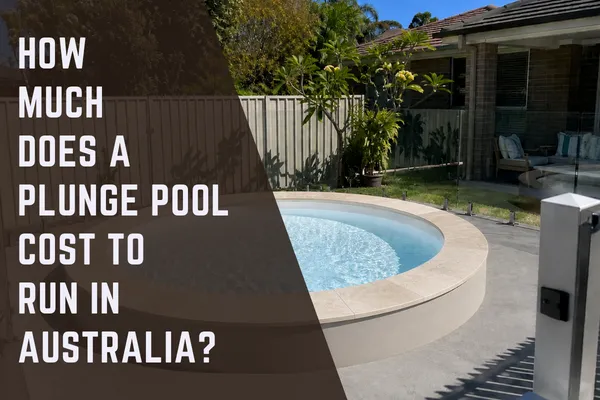
How Much Does A Plunge Pool Cost To Run In Australia?
Everyone asks about the price tag. Almost nobody asks about the power bill. However, running costs are where pool ownership quietly gets expensive — or stays refreshingly cheap. So before you commit to any pool, you deserve real numbers, not vague reassurance.
The short answer: a typical Aussie Plunge Pool™ costs roughly $300–$450 a year to run unheated — around $1 a day. That covers your pump, chemicals and water top-ups. By comparison, industry guides put concrete and fibreglass pools at $1,200–$1,800 a year, with full-size pools higher still. The difference comes down to water volume: less water means less pumping, fewer chemicals and far less to heat.
Here's how those numbers break down, line by line.
What Does It Cost To Run A Plunge Pool Each Year?
A poly plunge pool has three regular running costs: electricity for the pump, water chemistry, and occasional top-up water. Heating is a fourth, optional cost that many owners skip entirely. In short, here's the yearly picture for a typical 5,000L–10,000L Aussie Plunge Pool™:
These are estimates based on typical Australian electricity and water rates, and your numbers will shift with your tariff, climate and habits. That said, the pattern holds everywhere: a small pool is a cheap pool to run.
Does A Plunge Pool Use Much Electricity?
No — and this surprises people who've owned a full-size pool. A plunge pool needs only a small filtration pump, because there's far less water to turn over. For example, a compact pump suited to a 5,000L or 7,000L Aussie Plunge Pool™ draws a few hundred watts, not the kilowatt-plus of big pool equipment.
Run that pump four hours a day at a typical rate of around 33 cents per kilowatt-hour, and you're looking at roughly 50 cents a day. As a result, most owners land between $150 and $250 a year, depending on run times and their electricity plan.
You can trim this further. Run the pump during off-peak hours, or in the middle of the day if you have solar panels. Meanwhile, in winter you can drop run times back, because cooler water needs less filtration.
How Much Do Chemicals Cost For A Small Pool?
Chemical costs scale with water volume, and this is where a plunge pool wins convincingly. A traditional backyard pool holds 40,000–60,000 litres. An Aussie Plunge Pool™ holds 5,000 to 11,000 litres. Because of this, every dose of chlorine, every pH adjustment and every clarifier treatment costs a fraction of what a big pool demands.
In practice, most owners spend $100–$180 a year on chemistry for a poly plunge pool. That covers sanitiser, pH balancers and a test kit. On top of that, the smaller volume responds quickly to correction — a water balance issue that takes days to fix in a big pool often resolves overnight in a plunge pool.
Your water choice matters here too. Chlorine remains the cheapest to run, while magnesium and salt systems trade slightly higher setup costs for softer water. Our guide to magnesium, salt or chlorine walks through the options in detail.
What About Water Costs?
Filling a plunge pool costs less than most people expect. At typical Australian water rates of around $2.50–$3.00 per kilo-litre, a full 5,000L fill costs under $15. Even the 11,000L Infinity-8 fills for around $30.
After that first fill, you're only topping up evaporation and splash-out. For most Australian backyards, that means $20–$40 a year. Furthermore, a fitted cover slashes evaporation — which is one more reason we recommend one for every pool.
Do You Need To Heat A Plunge Pool?
Heating is a choice, not a requirement. Many Aussie Plunge Pools owners never heat their pool at all. Cold water is the point — a morning cold plunge, a post-workout soak, hydrotherapy for recovery. For that lifestyle, your heating cost is exactly zero.
If you do want warmer water for winter soaking, a small heat pump is the efficient option. Heating 5,000–10,000 litres costs far less than heating a 50,000-litre pool, and a solar cover holds that warmth in overnight. As a result, seasonal heating typically adds $200–$500 a year rather than the $700–$1,100 that industry guides quote for heated concrete and fibreglass plunge pools.
Two of our earlier guides cover this ground in depth: heating your plunge pool compares every option, and why every pool needs a solar cover explains how a cover pays for itself.
Why Do Poly Plunge Pools Cost Less To Run?
Three reasons, and they all come back to design.
First, water volume.
Every running cost — pumping, chemistry, heating, top-ups — scales with litres. A pool one-fifth the size costs a fraction as much to keep, week after week, year after year.
Second, one-piece construction.
Every Aussie Plunge Pool™ is rotomoulded in a single piece at our Alstonville factory in northern NSW. There are no seams, liners, gelcoat layers or rendered surfaces to maintain, repair or resurface. Meanwhile, concrete pools need acid washing and resurfacing over their lifetime, and those jobs run into the thousands.
Third, simple equipment.
A plunge pool needs a small pump and a sand filter — that's the whole engine room. Fewer components means lower electricity use and fewer parts to service or replace.
Most importantly, this isn't a compromise. The 5-year shell warranty, designed for a 20+ year lifespan, means the low running costs continue for decades. UV-stabilised polyethylene shrugs off the Australian sun without fading, cracking or resurfacing.
The Full Cost Of Ownership Picture
Running costs only tell half the story, so let's finish the sum. Traditional pools cost $35,000–$150,000+ to install, then $1,000–$1,800 a year to run. In contrast, an Aussie Plunge Pool™ starts at $4,550 with factory-direct pricing, and the Aussie Splash Pool™ range starts at just $3,250. Add roughly $300–$450 a year in running costs, and the ten-year ownership gap stretches well past $40,000.
That's the real affordability argument. A fraction of traditional pool costs upfront — and a fraction of the running costs every year after. Pair this with the 15-minute weekly maintenance routine and you have a pool that asks very little of your wallet or your weekend.
Frequently Asked Questions: Plunge Pool Running Costs
How much does a plunge pool cost to run per year in Australia?
A typical unheated poly plunge pool costs around $300–$450 a year to run — roughly $1 a day. That covers pump electricity ($150–$250), chemicals ($100–$180) and water top-ups ($20–$40). Heated concrete and fibreglass plunge pools typically run $1,200–$1,800 a year. Browse the Aussie Plunge Pools range to compare sizes and volumes.
Does a plunge pool use a lot of electricity?
No. A plunge pool runs a small filtration pump for a few hours a day, which costs most owners $150–$250 a year at typical Australian rates. Running the pump off-peak or on solar power lowers this further.
Is it expensive to heat a plunge pool?
Only if you want it to be. Many owners keep their pool unheated for cold plunge and hydrotherapy use, which costs nothing. Seasonal heating with a small heat pump and a solar cover typically adds $200–$500 a year — far less than heating a full-size pool.
How much does it cost to fill a plunge pool?
Under $15 for a 5,000L pool and around $30 for the largest 11,000L model, at typical Australian water rates. After the first fill, you only top up evaporation and splash-out. Check each model's capacity on the size guide.
Are plunge pools cheaper to run than normal pools?
Yes, substantially. A plunge pool holds 5,000–11,000 litres versus 40,000–60,000 litres in a traditional pool, so every running cost — pumping, chemicals, heating and top-ups — shrinks with it. Over ten years, the combined purchase and running cost gap can exceed $40,000.
Ready To Own A Pool That Barely Touches Your Power Bill?
An Aussie Plunge Pool™ delivers real pool ownership for around $1 a day in running costs — soak, float, cool off or cold plunge without watching the meter. Every pool is rotomoulded in Australia by Duraplas Industries, family-owned since 1984 and ISO9001:2015 certified, and delivered Australia-wide with factory-direct pricing.
Explore the full range, sizes and colours at www.aussieplungepools.com.au, or call our team on (02) 6628 7948 for a straight answer on the right pool for your backyard.
