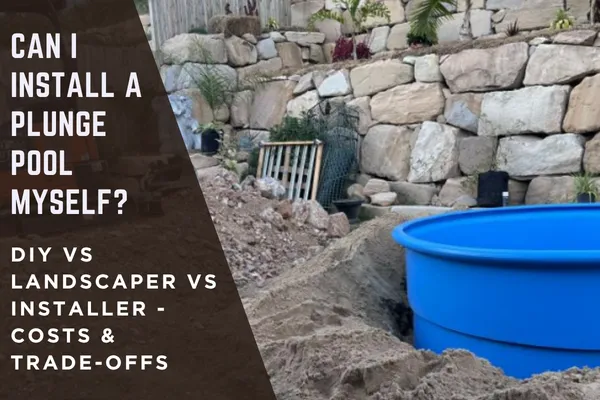
Can I Install A Plunge Pool Myself? DIY Vs Landscaper Vs Installer - Costs And Trade-Offs
You've picked your size, chosen your colour and checked the price. Then one question stops the whole plan: who's actually going to put this pool in? For many buyers, this is the moment a pool idea stalls for months.
The good news is that you have three clear routes, and each one suits a different backyard and a different budget. You can do it yourself, bring in a landscaper for the heavy work, or hand the whole project to a builder. Below, we compare all three on cost, time and trade-offs, so you can pick a route and get moving.
In a nutshell: Yes, you can install a plunge pool yourself. An above-ground Aussie Plunge Pool™ on flat ground is a realistic weekend job for a handy owner, and the only trade you must hire is a licensed electrician for the pump's power point. However, sloped blocks, semi-inground and in-ground installs usually call for a landscaper or excavator, which adds cost but saves a lot of digging.
What Does Installing A Plunge Pool Actually Involve?
Installing a plunge pool comes down to four jobs: building the base, getting the shell into position, connecting the plumbing and filtration, and supplying power. Once you split the install up this way, the "DIY or trades?" question gets much easier. In most cases, you're not choosing one route for everything. Instead, you're choosing who handles each job.
Plunge pool installation jobs: which ones you can DIY and when to call a trade
Job | Can you DIY it? | When you'll want help |
|---|---|---|
Base or pad | Yes, for a crusher-dust pad on flat ground | Sloped blocks, concrete slabs, excavation |
Moving and positioning the shell | Yes, for the round models with two or three helpers | The ~300kg Infinity-8 model. Or tight access that needs a crane truck |
Plumbing, skimmer box and filtration | Yes, with the included install guide | Rarely, unless you're adding heating or jets |
Power for the pump | No | Always: a licensed electrician |
On top of these four jobs, every pool also needs a compliant safety barrier, which we cover in our Australian Pool Regulations 101 guide. For the step-by-step detail on bases, access and delivery day, see our Site Preparation guide. This post focuses on the bigger decision: which route suits you.
Route 1: Full DIY
Full DIY means you build the base, position the shell and connect the plumbing yourself, and you hire an electrician only for the power point. It's the cheapest route by a long way. It's also, for that reason, the route most Aussie Plunge Pools owners take for an above-ground install.
Who does it suit?
This route suits flat or gently sloping yards, clear side access, and owners who are comfortable with a shovel, a spirit level and a weekend of physical work. Above all, it suits anyone who wants to put their budget into the pool itself rather than labour.
What does it cost?
Beyond the pool and delivery, full DIY costs typically come down to three items:
Base materials and equipment hire. A compacted crusher-dust pad usually costs a few hundred dollars in materials, plus a day's plate compactor hire.
Electrician. A single outdoor power point typically costs around $175–$500, depending on the outlet, location and cable run. If your switchboard needs a new dedicated circuit, budget roughly another $650–$1,100.
Helpers. Two or three friends to move the shell, which usually costs a barbecue and a few cold drinks.
What are the trade-offs?
The main cost of DIY is your time and effort. Base prep usually takes a weekend, and the base has to be level within a few millimetres to protect the shell long term. As a result, rushing the base is the most common DIY mistake. Each Aussie Plunge Pool™ comes with an illustrated install guide and engineer's drawings, so work from those rather than guesswork.
Route 2: DIY Plus A Landscaper
The hybrid route means a landscaper or excavator handles the heavy earthworks, and you handle the rest. For many backyards, therefore, this is the sweet spot. It suits anyone who wants a semi-inground or in-ground look, or has a block that isn't flat.
Who does it suit?
Bring in a landscaper when your install involves any of the following:
A sloped block that needs terracing or engineered retaining walls
A semi-inground or fully in-ground install, which means real excavation and careful backfilling
A concrete slab rather than a crusher-dust pad
Decking or cladding around the pool
What does it cost?
Landscaping costs vary widely by region and job size, so treat these as indicative 2026 figures:
Landscaper rates run roughly $55–$110 per hour. However, most landscapers quote a fixed price for the whole job.
Mini excavator with operator typically costs around $130–$195 per hour, plus a delivery or float fee of roughly $250–$380. Many operators charge a minimum of half a day or a full day.
Concrete slabs average around $100 per square metre nationally. That said, concreters often have minimum job charges, so a small pool slab can cost more per square metre than the average.
What are the trade-offs?
Naturally, you'll spend more than with full DIY, and you'll need to fit in with a tradie's schedule. In spring, that matters, because landscapers' calendars fill quickly before summer. On the other hand, you save days of digging and get a professional base under your pool. Meanwhile, you still save by doing the positioning, plumbing and fill yourself.
For design ideas on this route, read our guide to Semi-Inground Pool Design.
Route 3: Hand The Whole Job To A Builder Or Installer
The full-service route means a local landscaper, builder or pool installer manages the whole project for you, from base to first fill. It costs the most, but you do the least.
Who does it suit?
This route suits busy households, owners who aren't physically able to do the work, and complex projects. For example, a fully in-ground install with a deck, cladding and a new fence has several trades working in sequence. In that case, one person managing the whole project can save a lot of stress.
What does it cost?
Full-service pricing depends entirely on the scope of work, so get at least two written quotes. Also ask each one to separate base, earthworks, positioning, plumbing, electrical and barrier costs. That way, you can compare quotes line by line and see exactly where your money goes.
What are the trade-offs?
In short, you pay for convenience, and you'll wait for a tradie's availability. Even so, an Aussie Plunge Pool™ install takes far less labour than a traditional pool. Because the shell arrives as one finished, rotomoulded piece, there's no formwork, no spraying and no 28-day concrete cure. Our Polyethylene Advantage post explains why.
How Much Does Each Install Route Cost?
Here's how the three routes compare at a glance. These are indicative trade costs only and exclude the pool, delivery and safety barrier.
Plunge pool install routes compared: full DIY vs DIY plus landscaper vs full service
Comparison | Full DIY | DIY + landscaper | Full service |
|---|---|---|---|
Best for | Above-ground on flat ground | Slopes, semi-inground, slabs | Complex or in-ground projects |
Typical extra costs | Base materials, compactor hire, electrician | Plus excavation, slab or retaining, landscaper's labour | Fully quoted project price |
Your time | A weekend or two | A day or two | Minimal |
Trade bookings needed | Electrician only | Electrician + landscaper or excavator | Managed for you |
Biggest risk | An uneven base | Waiting for trade availability | Cost creep without itemised quotes |
Indicative trade costs only, October 2026. Excludes the pool, delivery and safety barrier. Get itemised quotes for your site.
Which Install Route Suits Your Backyard?
In most cases, your backyard makes the decision for you. Start with your ground, your access and the look you want, then match a route to them:
Flat lawn, clear side access, above-ground install→ Full DIY
Gentle slope or a semi-inground look→ DIY plus a landscaper
Steep slope→ A landscaper, plus engineered retaining walls before any pool work begins
Fully in-ground with decking or cladding→ DIY plus a landscaper, or full service
No side access→ Any route, plus a crane truck. A small crane truck for a single lift often costs a few hundred dollars when you book it ahead.
In addition, measure your access route before you choose. An unplanned crane on delivery day is one of the most avoidable extra costs in any install.
Why Poly Makes DIY Realistic
Most pool types simply aren't a job owners can take on themselves. Concrete pools need formwork, steel and curing time, while large fibreglass shells usually arrive by crane. An Aussie Plunge Pool™ is different. It's rotomoulded in one piece from UV-stabilised polyethylene, and it weighs roughly 125kg to 300kg dry depending on the model.
Because of this, a few people can roll most shells into place on a trolley. Furthermore, there's no curing time and no specialist pool crew. Duraplas Industries, the family business behind Aussie Plunge Pools, has been rotomoulding polyethylene at its Alstonville factory in the Northern Rivers of NSW since 1984. That experience shapes how simple each install is designed to be.
Frequently Asked Questions: Installing A Plunge Pool
Can I install an Aussie Plunge Pool™ myself?
Yes. Aussie Plunge Pools are designed for DIY installation, with an illustrated install guide, engineer's drawings and council-friendly documentation included. Most owners build the base, position the shell and connect the plumbing themselves. The one job you can't DIY is the outdoor power point, which needs a licensed electrician.
How much does it cost to install a plunge pool?
A DIY above-ground install often costs a few hundred dollars for base materials and equipment hire, plus roughly $175–$500 for an electrician to fit an outdoor power point. Semi-inground and in-ground installs cost more, because excavation and landscaping labour add to the total. See our Site Preparation guide for what the base involves.
Do I need an electrician to install a plunge pool?
Yes, if you're running a pump and filter. In Australia, only a licensed electrician can install a new outdoor power point. So book them early, and the power will be ready before delivery day.
Can a landscaper install my plunge pool?
Yes. Many owners hire a landscaper for excavation, retaining, slabs or decking, then handle the positioning and plumbing themselves. Ask for a fixed, itemised quote, and share your engineer's drawings with them before work starts.
How long does a DIY plunge pool install take?
Base prep typically takes a weekend. After that, an above-ground Aussie Plunge Pool™ can usually be positioned, plumbed and filled over a single weekend, with the water balanced and ready for a soak shortly after.
Ready To Choose Your Pool?
Whichever route you take, it starts with the right pool for your space. Visit www.aussieplungepools.com.au to see every size, colour and current price, or call us on (02) 6628 7948 to talk through your backyard and the best install route for it.
Aussie Plunge Pools™ - affordable polyethylene plunge pools, made by Duraplas Industries, Australian family-owned since 1984, and delivered Australia-wide.
