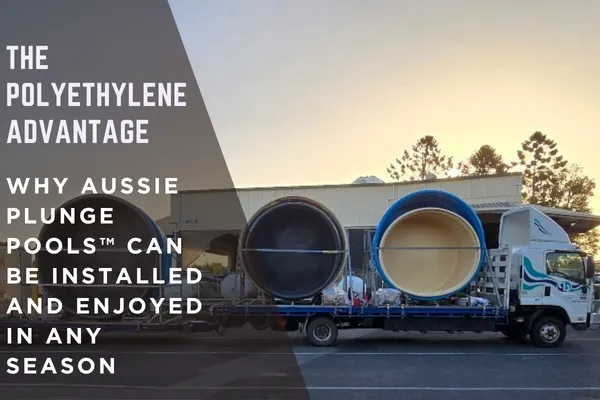
The Polyethylene Advantage: Why Aussie Plunge Pools™ Can Be Installed and Enjoyed in Any Season
Most people assume installing a pool is a warm-weather project. Book it for spring. Wait for summer. Hope the weather holds. It's a reasonable assumption — but it's one that doesn't apply to a polyethylene plunge pool.
In short, a roto-moulded poly plunge pool from Aussie Plunge Pools™ can be delivered, installed, filled, and ready to use in a single weekend — regardless of the season, regardless of the temperature, and regardless of whether the forecast looks perfect. The material itself is the reason why.
This post breaks down the technical advantages of polyethylene construction that make it uniquely suited to year-round installation across Australia — from the tropical north down to frost-prone southern climates — and why those same properties translate into a better ownership experience for decades after install day.
What Is Polyethylene?
Polyethylene is the same family of materials used in water storage tanks, kayaks, and heavy-duty industrial containers — products that need to handle temperature extremes, UV exposure, and physical stress without failing. It's not a new material. But it is a proven one.
Aussie Plunge Pools™ are manufactured from UV-stabilised polyethylene using a process called rotational moulding — or roto-moulding. The pool shell is formed as a single, seamless piece, with shot weights that exceed industry standards. There are no joins to leak, no seams to stress, and no composite layers to delaminate. The result is a shell that's simultaneously lightweight and structurally robust — and that's exactly where the seasonal installation advantages begin.
No Curing Time. No Weather Windows. No Waiting.
Concrete pools are impressive structures. They're also extraordinarily time-sensitive to build.
After the concrete is poured, it requires a curing period of up to 28 days before the pool can be filled. During that window, temperature and moisture conditions matter enormously. Cold weather slows the chemical reaction that gives concrete its strength. If temperatures drop too low during the cure, the concrete can crack, weaken, or fail to set properly — meaning delays, remediation work, and added cost before a single swimmer gets near the water.
Polyethylene has none of these constraints. The Aussie Plunge Pools™ shell arrives at your property already manufactured, already cured, and structurally complete. There's no on-site curing process or critical temperature window to hit. And there is no waiting for conditions to align before the install can proceed. In reality, this means a poly plunge pool can go from delivery to swim-ready in a single weekend — winter included.
How Does Poly Handle Australian Temperature Extremes?
This is where the UV-stabilised construction earns its keep.
Australia asks a lot of outdoor materials. Far North Queensland delivers punishing UV radiation and humidity year-round. Alpine areas of Victoria and New South Wales bring regular winter frost. The inland regions of both states swing between blistering summer heat and cold winter nights. A pool shell that performs beautifully in Cairns needs to hold up just as well in the Southern Highlands.
Aussie Plunge Pools™ are engineered for exactly this range. The UV-stabilised polyethylene is formulated to resist the degradation that sunlight causes in lesser materials — the fading, the brittleness, the surface breakdown that shortens the life of cheaper alternatives. Meanwhile, the one-piece roto-moulded construction means there are no bonded joints or composite layers that expand and contract at different rates in response to temperature changes.
Furthermore, because poly is inherently flexible under load rather than rigid and brittle, it handles ground movement and temperature-driven expansion without cracking. This is an important advantage in climates where the ground frosts in winter and bakes in summer — conditions that place concrete structures under repeated freeze-thaw stress over time.
The result is a shell designed for a 20-plus year lifespan, backed by a 5-year warranty, and built to perform across the full breadth of the Australian east coast — from North Queensland to Melbourne.
Above-Ground Installation: Bypassing the Seasonal Excavation Problem
One of the most under-appreciated advantages of a poly plunge pool is the ability to install it fully above ground.
Excavation is deeply weather-dependent. Rain turns a manageable dig into a muddy, unstable worksite. Winter ground conditions — particularly in southern states — can make excavation equipment difficult to operate and the excavated ground harder to compact and stabilise. In the southern states, scheduling earthworks in winter often means competing for contractor availability and absorbing delays when conditions deteriorate.
An above-ground poly plunge pool sidesteps this entirely. The installation requires a compacted, level pad — typically crusher dust or concrete — and the pool is positioned, plumbed, and filled from there. No excavation. No earthworks. No dependence on dry weather windows.
For customers in frost-prone areas of Victoria, the Snowy Mountains region, or inland New South Wales, this is particularly significant. The installation timeline is no longer dictated by ground conditions or the calendar. It's dictated by when you're ready.
Additionally, a semi in-ground installation — where the shell sits partially below grade — offers a middle path. You get a lower profile and a more integrated visual result, with significantly less excavation than a full in-ground install demands. This approach remains achievable in most weather conditions and most seasons.
The Weight Advantage in Winter Conditions
A poly shell from Aussie Plunge Pools™ weighs between approximately 125kg and 300kg depending on the size. For context, that's light enough for a couple of people to manoeuvre with the right equipment — or for a single hi-ab lift if access demands it.
Compare this to a fibreglass shell, which requires crane hire and a larger crew, or a concrete structure that is, by definition, inseparable from the ground once built. The lightweight nature of polyethylene means the installation itself is simpler, faster, and less reliant on heavy machinery or large teams — all of which become harder to coordinate in winter months.
In short, less weight means fewer dependencies. Fewer dependencies means more flexibility around timing. And more flexibility means you're not at the mercy of season, weather, or contractor schedules to get your pool in the ground — or above it.
A Pool That Performs Year-Round, Not Just in Summer
The case for polyethylene installation in any season isn't just about getting the pool in faster. It's about what that pool does once it's there.
Aussie Plunge Pools™ are equally well-suited to warm-weather cooling and cold-weather therapeutic use. Because the pool volume is compact — 5,000L, 7,000L, or 10,000L — a heat pump or solar heating system brings the water to temperature efficiently. Many owners run their pool year-round, enjoying the proven benefits of cold-water immersion in cooler months and refreshing relief in summer.
Moreover, the poly shell's thermal properties mean the water temperature is relatively stable compared to a large concrete pool, which can be difficult and expensive to heat to a comfortable temperature in winter. Smaller volume, efficient heating, year-round usability — the polyethylene advantage compounds well beyond install day.
Why This Matters for Buyers Across the East Coast
Aussie Plunge Pools™ are delivered across the full length of Australia's east coast — from North Queensland through New South Wales and down to Victoria. That's a remarkable range of climates, from subtropical heat to real winter frost, and every Aussie Plunge Pool™ shell is manufactured to perform across all of it.
For buyers in warmer northern climates, the all-season installation advantage simply means there's no reason to delay. For buyers further south, it means winter isn't a barrier — it's just another weekend.
The manufacturing heritage matters here too. Duraplas Industries has been producing rotationally-moulded polyethylene products in Australia since 1984. That's more than four decades of understanding what Australian conditions ask of a shell — and building to exceed it.
The Short Version, If You Need It
A polyethylene plunge pool from Aussie Plunge Pools™ can be installed in a weekend, in any season, across any Australian climate, without curing delays, without excavation if you choose above-ground, and without risk of frost damage or temperature-related shell failure. It's built from the same category of material used in products designed to last decades in harsh outdoor conditions — and it's engineered specifically for the extremes of the Australian environment.
Concrete waits for the weather. Poly doesn't.
If you're ready to stop waiting for the right season and start enjoying the right pool, visit www.aussieplungepools.com.au to explore the full range of sizes and colours — and get your Aussie Plunge Pool™ delivered Australia-wide.
