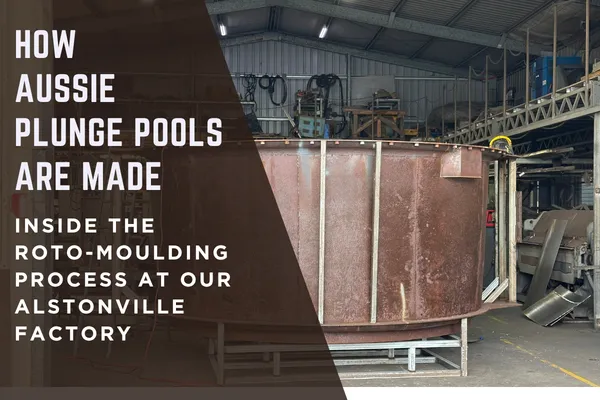
How Aussie Plunge Pools Are Made: Inside The Roto-Moulding Process At Our Alstonville Factory
Most pool companies can't tell you where their shells come from. Many arrive in shipping containers from overseas factories nobody has ever visited. Aussie Plunge Pools is different. Every single shell begins life as polyethylene powder compounded onsite at the Duraplas factory in Alstonville, Northern NSW — and ends as a one-piece Australian-made pool with no joins, no seams and no welds.
So how does a pile of powder become a backyard pool? Come and take a look inside the factory.
The short answer: Every Aussie Plunge Pool is roto-moulded as a single seamless piece at the Duraplas factory in Alstonville, NSW. Food-grade polyethylene powder is loaded into an engineered mould, then cooked, soaked and cooled inside a biaxial gas-powered oven at 240–280°C. One shell takes 2.5 to 4 hours to mould, and the factory turns out 6 to 8 pools every 24 hours — 100% Australian made, from powder to finished pool.
What Is Roto-Moulding, And Why Does It Matter For A Pool?
Rotational moulding (roto-moulding) is a manufacturing process that creates hollow, one-piece products by rotating a heated mould on two axes at once. As the mould turns, molten polyethylene coats every internal surface evenly. The result is a single continuous shell with consistent walls and zero joins.
Because of this, a roto-moulded pool has no seams to split, no panels to separate and no layers to peel apart. That matters enormously in a product that holds thousands of litres of water for decades. In contrast, fibreglass pools are laminated in layers and finished with a gelcoat surface — a coating that can chip, fade or blister over time. A roto-moulded poly shell is the same material all the way through.
Duraplas Industries has been perfecting this process for 42.5 years. The company has been owned and operated by the same Australian family since 1984, and that manufacturing experience goes into every Aussie Plunge Pool shell.
The Five Steps From Powder To Pool
Every shell follows the same production sequence on the Alstonville factory floor:
Mould preparation. The team prepares the engineered mould and applies a release agent so the finished shell demoulds cleanly.
Material loading. A precisely measured weight of polyethylene powder goes into the mould. The weight determines the wall thickness, so accuracy here is everything.
PLC programming. The team programs the PLC computer that controls the entire cycle — temperatures, rotation and timing are all locked in before the oven door closes.
Cook, soak and cool. The mould enters the biaxial gas-powered oven, rotating on two axes while the polyethylene melts, fuses and forms the shell. It then soaks at temperature before a controlled cooling phase.
Demould, trim and cut. The finished shell comes out of the mould and gets trimmed, and the skimmer box provision is cut out of the shell — ready for the skimmer box to be fitted when the pool is installed onsite.
Every pool is moulded as a fully closed-top unit — the shell comes out of the oven as a completely sealed capsule, and the top is then removed to create the pool opening. That closed-top method is part of what guarantees an even, continuous wall right around the rim.
How Long Does It Take To Make A Plunge Pool?
A single Aussie Plunge Pool shell takes 2.5 to 4 hours to mould, depending on the size of the pool. Across a full 24-hour production cycle, the Alstonville factory produces 6 to 8 finished pools.
The oven runs at 240–280°C depending on shell size, with an optimum internal mould temperature of 200°C. That precise temperature control — managed by the PLC computer rather than guesswork — is what produces the smooth internal surface and consistent wall quality in every shell.
Currently, the factory produces around 300 pool shells a year. Furthermore, that number is climbing fast as more Australian families discover what a plunge pool adds to a backyard.
What Are Aussie Plunge Pools Actually Made Of?
Every Aussie Plunge Pool is made from food-grade linear low-density polyethylene (LLDPE), with a specially formulated additive package that creates the smooth internal surface you feel when you soak. In fact, the formulation is exclusive to Aussie Plunge Pools — a recipe developed in-house and compounded onsite at Alstonville.
This is not the same material used in water tanks. The pool-specific formulation was engineered for one job: making the best possible poly pool shell.
Why Doesn't A Poly Pool Need Reinforcement?
The LLDPE used in every shell is a C6-grade polymer. In plain terms, that means the molecular structure includes hexene branching, which ties the polymer chains together into a robust interlinked network. As a result, the strength is built into the material itself.
Fibreglass pools rely on layered laminates and structural ribs to achieve strength. A roto-moulded C6 poly shell needs none of that. The reinforcement is molecular, not bolted on — which is also why the shells stay so light. A 5,000L Aussie Plunge Pool weighs around 125kg dry, light enough to walk down a side path.
How Does The UV Protection Work?
UV20 stabilising additives are compounded into the polyethylene at the factory — through the entire wall thickness, not applied as a surface coating. This is the highest level of UV stability available in polyethylene manufacturing, and it's a key reason the shells carry a 5-year warranty and a design life of 20+ years under the harsh Australian sun.
Compare that with a gelcoat finish, where the UV protection is only as deep as the coating itself. On an Aussie Plunge Pool, there is no coating to fade, chip or wear through. The protection goes all the way to the core.
The Flec Colours: Moulded Through, Not Painted On
The signature Flec finish — available in Bondi Blueflec™, Byron Sandflec™, Southern Slateflec™, Whitsunday Whiteflec™ and Black Beachflec™ — is added at the point of manufacture of the virgin-grade polyethylene. The exact process is a closely guarded Duraplas secret. What we can tell you is what it means for you as an owner.
Both the flec and the base colour run consistently through the full thickness of the pool shell. The inside of the pool looks identical to the outside. Most importantly, the colour can never wear off, because it isn't a surface layer — it IS the shell.
That through-colour construction has a practical benefit too. If a shell ever picks up a minor surface mark, it can be professionally restored with careful heat treatment, returning the surface to its original condition. There's no paint to match and no gelcoat to patch, because the same colour runs all the way through.
What Quality Checks Happen Before Delivery?
Every Aussie Plunge Pool goes through rigorous post-mould testing before it leaves the factory. Duraplas Industries is ISO9001:2015 certified, which means documented quality assurance procedures are locked into the fabric of the company — from raw material batches through to the finished, skimmer-ready shell.
In other words, quality isn't a final inspection at the end of the line. It's checked and recorded at every stage of production. That's the peace of mind behind every pool that rolls out of Alstonville.
Is A Poly Plunge Pool Recyclable?
Yes. At the end of its long working life, an Aussie Plunge Pool shell can be fully recycled, and the recovered polyethylene can be used to manufacture a wide range of new products. This is emphatically not single-use plastic — it's a durable product designed for 20+ years of service, with a real second life waiting after that.
For families weighing up the environmental footprint of a backyard pool, that end-of-life story matters. A one-piece recyclable poly shell compares very favourably with demolished concrete or landfilled fibreglass laminate.
100% Australian Made — And Built With Tools We Made Ourselves
Every Aussie Plunge Pool is manufactured 100% in Australia — the polyethylene is compounded onsite, the shell is moulded, trimmed and quality-checked onsite, and it's the part of the story we're proudest of. Even the engineered moulds themselves are mostly manufactured in the Duraplas factory at Alstonville, in the Northern Rivers of NSW.
That level of vertical integration is rare in Australian manufacturing. It means complete control over material quality, mould precision and production standards — no imported shells, no overseas pool factories and no unknowns. Just one Australian family business, doing what it has done for more than four decades, and doing it a few hours' drive from the backyards it serves.
See The Craftsmanship For Yourself
The next time you lower yourself into an Aussie Plunge Pool for a cold plunge or a long soak, you'll know exactly what's beneath you: one seamless shell, roto-moulded in Australia from an exclusive polyethylene formulation, colour-moulded through its full thickness, UV-stabilised to its core, and quality-checked under ISO9001:2015 — all born in a biaxial oven in Alstonville.
Explore the full range of sizes, colours and factory-direct prices at www.aussieplungepools.com.au — and see what 42.5 years of Australian manufacturing know-how feels like in your own backyard.
