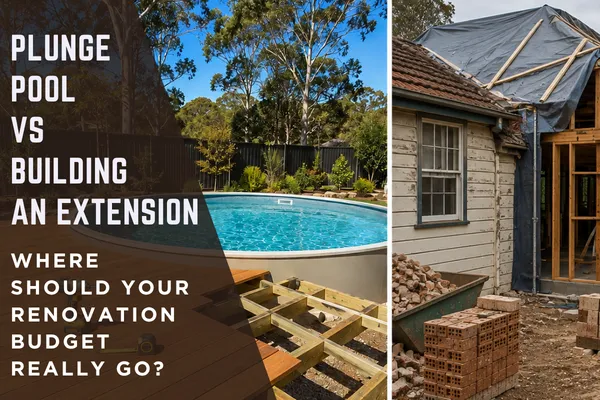
Plunge Pool Vs Building An Extension: Where Should Your Renovation Budget Really Go?
Every renovation budget eventually runs into the same fork in the road: spend it on more space, or spend it on a better version of the space you've already got. For a lot of Australian homeowners weighing up their next project, that comes down to a properly tricky comparison — a house extension versus a backyard upgrade like a plunge pool. They're not really the same kind of purchase, but they're often competing for the exact same dollars.
The short answer: a house extension typically costs $2,000–$5,500 per square metre in 2026, putting even a modest single-room addition at $35,000 or more before council and design fees. An Aussie Plunge Pool™ starts from $4,550 (plus delivery) for the 5,000L model, with the full range topping out at $11,995 for the largest in-ground option — a fraction of an extension's cost, installed in days rather than months. Which one is "right" depends less on price and more on what you actually need — extra functional space, or a better daily experience in the space you've already got.
What Does A House Extension Actually Cost In Australia?
Extension costs vary by region and finish level, but the 2026 industry consensus is fairly consistent: ground-floor extensions typically run $2,000–$5,500 per square metre, with most family-scale projects landing in the $2,800–$4,500 range. A single bedroom addition of 12–16 square metres commonly costs $35,000–$55,000, and a small 20–30 square metre extension usually lands between $80,000 and $150,000. Second-storey additions cost roughly 30–50% more again, thanks to the extra structural reinforcement, roof work, and staircase requirements.
Those figures cover construction only — they don't include design fees, council costs, or contingency for the structural surprises that older homes and reactive soil conditions tend to produce. Almost every extension needs council approval too, either through a fast-tracked complying development certificate (2–6 weeks) or a full development application (6–16 weeks), before a single wall comes down. Add construction time on top, and most extensions realistically take several months from decision to move-in — and for that whole stretch, you're living in or around a construction site.
What Does A Plunge Pool Actually Cost, By Comparison?
An Aussie Plunge Pool™ sits in a completely different budget bracket. The range starts at $4,550 (plus delivery) for the 5,000L round shell, rising to $5,950 for the 7,000L, $6,950 for the 10,000L, and $7,350 for the 10,500L deep model. At the top of the range, the 11,000L Infinity 8 sits between $9,950 (in-ground) and $11,995 (above-ground). Even the largest, most premium option in the range costs less than a single 12–16sqm bedroom addition, and the entry-level model is roughly an eighth of what a modest extension typically runs. The ongoing running cost is modest too — a well-set-up plunge pool costs around $1 a day to run across a full year, covering pump, chemicals and any heating.
The install timeline is just as different. There's no development application, no months of trades on site, and no structural engineering marathon — just a compacted, engineered base, an access plan, and a delivery day. Most installs go from empty backyard to filled pool inside a single weekend once the site's prepped, compared to the months an extension typically takes from approval to completion.
What Are You Actually Buying? Square Metres Vs Lifestyle
This is really the core of the decision, and it's worth being direct about the difference. An extension buys functional space — a bedroom, a bigger living area, a home office — that changes how many people a house can comfortably accommodate. A plunge pool buys a daily-use lifestyle amenity: a cold-water soak after work, a hydrotherapy routine, a spot to unwind that didn't exist in the backyard before.
Neither is "better" in the abstract. A growing family that's actually run out of bedrooms has a functional problem an extension solves and a pool doesn't. A household with enough space but no reason to look forward to coming home has a different kind of problem — and that's where a plunge pool tends to earn its keep.
Which Adds More Value To Your Property?
It's worth being straightforward here rather than overselling the pool side of this comparison. In most Australian markets, well-executed extensions — particularly extra bedrooms, bathrooms, or living space — remain one of the more reliable ways to lift a property's resale value, because they solve a problem (not enough space) that shows up directly in a valuer's assessment.
A plunge pool's value contribution is different in kind, not necessarily in size. It rarely adds resale value dollar-for-dollar the way an extra bedroom can, but it does two things an extension can't: it's portable, so if you sell or relocate, the pool can go with you rather than staying baked into the build. And for anyone weighing up a short-stay or holiday rental use for the property, a pool is one of the most-searched amenity filters on booking platforms — a different kind of return than resale value, but a real one.
How Long Does Each Renovation Actually Take?
An extension's timeline runs in months: weeks for council approval, then several more months of construction, during which the household typically lives around an active building site. A plunge pool's timeline runs in days: a weekend for base prep, a scheduled delivery day, and the pool is filled and running.
For anyone whose renovation tolerance is more about disruption than dollars, that gap matters as much as the price difference does.
Which Should You Choose? A Practical Framework
A few questions tend to cut through the decision quickly:
Do you have a real space shortage — not enough bedrooms, no functional living area — or is the issue more about how the existing space feels to live in? A real space shortage points toward an extension; everything else points toward a lifestyle upgrade.
How much disruption can your household tolerate? Months of construction is a different commitment to a single weekend of prep and delivery.
Are you planning to stay long-term, or could you move in the next few years? An extension is permanent. A plunge pool moves with you.
Does the budget actually stretch to a full extension? If a real space upgrade is out of reach this year, a plunge pool can be a meaningful renovation on its own rather than a consolation prize.
For a lot of households, the real answer isn't either/or — it's sequencing. A plunge pool now, on a modest slice of the renovation budget, and an extension further down the track once it's properly funded.
Frequently Asked Questions: Plunge Pool Vs House Extension
Is a plunge pool cheaper than a house extension?
Yes, significantly. Even a modest single-room extension typically starts around $35,000–$55,000 before council and design fees, while the full Aussie Plunge Pool™ range runs from $4,550 to $11,995 plus delivery — the entry-level model costs roughly an eighth of a small extension.
Does a pool or an extension add more value to my home?
An extension generally adds more direct resale value, since extra bedrooms or living space address a problem valuers can measure. A plunge pool adds lifestyle appeal and, for short-stay properties, booking appeal — a different kind of value, not necessarily a larger one.
How long does each project take?
An extension typically takes several months from council approval through to completion. A plunge pool can go from an empty backyard to filled and ready to use within a matter of days once the site is prepared.
Can I do both if my budget doesn't stretch to a full extension?
Many households sequence the two — a plunge pool now as an affordable, fast renovation, with an extension planned for later once it's properly budgeted.
What if I'm planning to move in a few years?
A plunge pool is portable and can be drained, transported, and reinstalled at a new property. An extension is a permanent addition to the home you're in.
Weighing up your renovation budget? Visit Aussie Plunge Pools and see current sizes and colour-ways from Aussie Plunge Pools — factory-direct, Australian family-owned since 1984.
