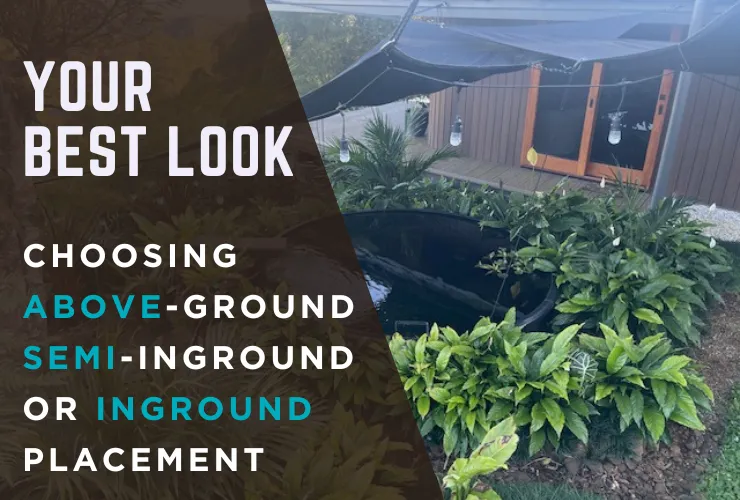
Your Best Look: Choosing Above-Ground, Semi-Inground, or Inground Placement
Your backyard isn’t a leftover rectangle behind the house—it’s another room you get to design and put your unique flair too. Where your Aussie Plunge Pool™ sits is more than a technical decision about access or timelines; it’s a creative choice that sets the mood of the whole home. Think of placement as your first, boldest design move: will the pool stand proud as a sculptural object (above-ground), sink quietly into the landscape (inground), or nestle halfway to create that calm, resort bowl (semi-inground)? Each option shapes sightlines, rhythms, and how you’ll live outside—from morning coffee rituals to golden-hour swims with friends.
This guide leans into the aesthetics—how form, materials, planting and light work together—so you can choose a placement that feels like you. We’ll draw on contemporary Australian design cues (indoor–outdoor flow, textural minimalism, plant-rich spaces) and several evidence-backed ideas: people tend to prefer curved forms (your round pool is already working in your favour), and spaces that connect us to nature reliably make us feel calmer and more at home.
Above-Ground: Sculptural, Fast, and Joyfully Obvious
Design Vibe
Your pool is an object—just like your dining table in your dining room—and it anchors the composition of your backyard. Above-ground placement celebrates the circle: it’s graphic, legible and photogenic. Position it slightly off-centre to soften the boxy edges of most Aussie yards, and let the curve set the furniture plan: a half-moon breakfast nook, a crescent of low loungers, or a slim café ledge for two.
Material Palette
Keep it crisp and contemporary. Think porcelain pavers with a gentle grain, or clip-together composite tiles for a quick, refined deck surface. Use one dominant tone (warm sandstone, pale grey, or charcoal) so the round water reads as the hero colour. Choose slip-appropriate surfaces for wet zones; in Australian practice you’ll commonly see P4–P5 (or ramp class R11) specified around pools—ask your supplier for ratings that fit your micro-conditions (kids, shade, slope).
Planting & Backdrop
Because the pool sits proud, keep planting low and textural so it doesn’t fight the silhouette. Strappy natives and tidy evergreens such as Lomandra, Dianella and compact lilly pilly, frame the circle without dropping mess into the water. Layer one taller specimen (olive, bay, or a slim native) behind your seating to “cap” the view like a mantelpiece, and leave clear negative space elsewhere—the object needs room to breathe. Hot tip: Biophilic design principles—texture, greenery, views—aren’t just pretty; they’re scientifically proven to support wellbeing.
Lighting Mood
Treat the pool like a sculpture at night. Use low-glare path markers for function, then a soft wash on the nearest fence or feature tree to create depth, and one small sparkle element like a pendant or festoons at a safe distance, for a festive edge. Outdoor lighting works best in layers—task, ambient, accent—to guide the eye and keep the water calm.
When It’s Perfect
Rentals and fast transformations. Above-ground pool placement exudes confidence and 'move-in ready'—a decisive way to claim your outdoor room this season.
Semi-Inground: The Quiet Bowl & The Designer’s Sweet Spot
Design Vibe
Half-set placement lowers the rim so the circle becomes a gentle basin in the landscape—this looks serene in photos and is deeply relaxing in person. Your eyes glide over the coping and settle on the water, not walls. It’s the look that makes visitors say, “Wait… how does your yard feel bigger now?”
Spatial Trick
Let the rim act like a datum line. Build a curved bench-arc on the house side at seat height; on the opposite arc, keep a slender planting band to soften the horizon. This asymmetry makes the space feel designed, not plonked. Designers often use semi-inground moves to tame sloped sites and tiny terraces: less dig than a full inground and far more calm than a tall above-ground wall.
Material Palette
Aim for tactile quiet. Porcelain or stone with a honed finish, decking with tight shadow gaps, woven outdoor textiles in natural tones. Limit yourself to two hardscape textures (for example: pale paver + timber bench), then bring richness with planting and light. Curves are emotionally soothing—use that to your advantage by echoing the pool’s arc in seat fronts and planter edges.
Planting & Privacy
Semi-inground lets greenery sit closer to the eye. Keep it non-littering and pool-tolerant; group plants by height so the horizon steps down towards water. If you need screening, choose slatted elements or dense planting outside barrier lines so the composition stays soft. Designers routinely balance safety and style—think compliant lines that disappear behind planting while maintaining the required clear zones.
Lighting Mood
Choose a warm bench glow under-seat or toe-kick, discreet path markers in the walking loop, and a single hero uplight to a tree or sculptural grass. The aim is a bowl of stillness with just enough sparkle to feel magical.
When It’s Perfect
Small yards, design lovers and sloped blocks. Semi-inground is the “best of both” aesthetic with minimal visual clutter.
Inground: The Disappearing Act - Pure Lines + Garden First
Design Vibe
Inground placement lets paving or lawn run right to the edge, making the circle feel carved into the ground plane. It’s wonderfully graphic from upper floors and decks aa the pool acts as negative space and the garden gets to be the star. If your interior opens with big sliders, inground reads as a seamless extension of the living room—a mirror of sky stitched into the terrace.
Material Palette
Keep the field consistent and let the water be the colour. A single paving material across terrace and coping creates gallery-like calm. To avoid “flatness,” add micro-textures: a linen-weave outdoor rug, braided chairs, ribbed planter pots. Many Australian projects that win attention use restraint and detail—few materials yet perfectly handled.
Planting & Horizon
With the pool essentially flush choose plant masses rather than singles for a contemporary, restful read. Repeat species in drifts to avoid visual chatter. Curate one distant focal point such as a sculptural tree, a stone, or an outdoor artwork. Creating sightlines such as these pull through the space so even a compact yard feels deeper when the eye has a destination.
Lighting Mood
Hide the hardware. Conceal linear grazers along low walls, use recessed step lights where the terrace changes level, and let a single specimen tree carry the night scene. The water should feel ink-calm, not a lit stage.
When It’s Perfect
Architectural minimalists, long-term homes, and gardens where plants—not walls—should lead.
Gather Inspiration With These Three Designer Playbooks
Soft Modern Coastal
Palette: driftwood decking, off-white pavers, sea-grass textiles.
Plants: Westringia, Lomandra, olives; powdery greens for glare control.
Light: warm festoons at a safe distance for weekends, path markers for everyday.
Placement: semi-inground with a curved bench-arc—the relaxed holiday look, all year.
Inner-City Courtyard Gallery
Palette: one porcelain field, charcoal furniture, a single terracotta accent.
Plants: structured clumps (dwarf lilly pilly, upright rosemary) for sculptural shadows.
Light: minimal—just a rim wash and one hero uplight.
Placement: inground for pure lines that make tight spaces read larger.
Green Sanctuary
Palette: muted stone, timber seat backs, linen cushions.
Plants: layered textures—bromeliads, Dianella, compact hedges—arranged in drifts.
Light: bench glow + tree halo; low lux, high calm.
Placement: above-ground (sculptural) or semi-inground (bowl-like), depending on how much presence you want.
The Designer’s Shortlist - What Really Matters
Emotion first, details second.Pick the placement that matches the feeling you want: statement (above), serenity (semi), or seamlessness (in). Curved forms naturally relax most people—use that to your advantage with matching arcs in furniture and beds.
Edit your materials.Two hard textures + planting + water is usually enough. That restraint is what gives high-end Australian projects their quiet luxury.
Green for wellbeing.Biophilic design isn’t a trend piece; it’s measurable comfort. Prioritise greenery, views, breezes and natural texture—the outdoor room will feel like part of the home, not an afterthought.
Safety that disappears.Plan compliant barrier lines first, then “hide” them with alignment, planting outside clear zones, and refined detailing. It’s how designers balance style with family peace-of-mind.
Before You Dive In
Placement is your signature. Above-ground celebrates the object, semi-inground calms the frame, and inground lets the garden lead. None is “more correct”—only more you. Start with the feeling you want when you step outside, choose the placement that expresses it, and let the circle do what circles do best: soften the geometry, slow the eye, and invite you to live outdoors every day.
