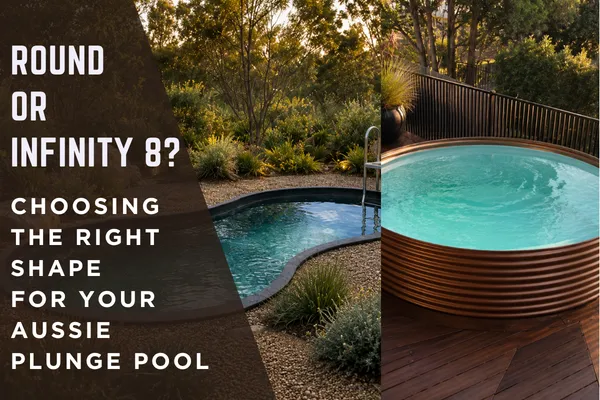
Round Or Infinity 8? Choosing The Right Shape For Your Aussie Plunge Pool
Spring's here, which means backyard plans are turning into actual decisions. If you've settled on getting a plunge pool, there's a question that comes before colour, cladding, or even size: which shape actually suits your block? Aussie Plunge Pools come in two distinct shapes — the classic round shell, and the newer Infinity 8 — and they're built for properly different backyards and different reasons.
The short answer: if you've got a compact or narrower backyard, want the lightest and easiest DIY install, or you're working with a tighter budget, a round shell is the practical pick. If you've got a larger block and want a sculptural, design-led centrepiece with room to spread out, the Infinity 8 is built for exactly that. One thing worth knowing upfront: the Infinity 8 doesn't add depth over the round range — it's the same 1,300mm as most round shells. What it adds is footprint and shape, not immersion depth.
What's Actually Different Between The Two Shapes?
The round range spans four sizes — from the 5,000L shell at 2.47m diameter up to the 10,500L deep model at 3.3m diameter and 1,500mm depth. Dry weight runs from 125kg to 190kg, and pricing spans $4,550 to $7,350.
The Infinity 8 is a different shape entirely: two connected circular zones within one continuous shell, giving it a figure-8 footprint rather than a single circle. It measures 5,000mm long by 2,500mm wide (4,100mm including support structures for the above-ground model), at a consistent 1,300mm depth. It's a substantially heavier shell at around 300kg dry weight, and it's priced at $9,950 for the in-ground version or $11,995 above-ground.
Quick Clarification: Is The Infinity 8 An "Infinity Pool"?
Worth addressing directly, because the name invites the question: no, the Infinity 8 isn't a vanishing-edge or zero-edge "infinity pool" in the resort sense. The name comes from its shape — two connected zones forming a figure-8, resembling the infinity symbol — not from any edge or overflow feature. If you're picturing water disappearing over a horizon-line edge, that's a different product category entirely. What the Infinity 8 does offer is a distinctive, sculptural silhouette that reads as a design feature in its own right, without needing an infinity-edge build to get there.
How Much Backyard Do You Actually Need?
This is usually the deciding factor before price even comes into it. A round shell's compact footprint — as little as 2.47m across for the smallest model — fits comfortably into most standard suburban backyards, including narrower courtyards and side-access blocks.
The Infinity 8's 5m length changes that calculation. It suits larger blocks — generally 300m² or more of usable backyard area — where there's room for the shell itself plus surrounding decking or landscaping. If you're on a tighter block, it's worth measuring your actual available space before falling for the shape alone; a round shell may be the only option that physically fits, regardless of preference. The same access-planning principles from our site prep guide apply here too — narrow side paths and gate widths matter just as much for a 5m shell as a 2.5m one, if not more.
Which Shape Actually Suits Your Lifestyle?
A round shell tends to suit first-time pool buyers, anyone working to a tighter budget, and smaller households wanting a straightforward, classic pool without a large footprint commitment. It's also the lighter option to move into position — a real consideration if you're planning a DIY roll-in with family or friends rather than a hi-ab lift. And because it's the shape most of our cladding guide is built around, it pairs easily with timber, stone, render, or Colorbond® finishes if you want to dress it up further down the track.
The Infinity 8 suits a different brief: a larger backyard, a bigger budget, and a real appetite for the pool to function as a design statement rather than just an amenity. The dual-zone shape naturally splits into two areas that can be used differently — one for settling in and relaxing, the other for a cooler dip — even though both sit at the same depth. It's available as a dedicated in-ground factory model, which matters if a flush, landscape-integrated look is part of the plan — though it's worth knowing the round range can be installed below-ground too, so an in-ground look isn't reserved for the Infinity 8 alone.
What About Depth? A Common Misconception
It's easy to assume the larger, more expensive shell is also the deeper one — it isn't. The Infinity 8 sits at 1,300mm, the same depth as most of the round range. If maximum immersion depth for serious cold-water therapy or hydrotherapy is actually the priority, the 10,500L Round Deep model is the one to look at — at 1,500mm, it's the deepest shell in the entire Aussie Plunge Pool range, Infinity 8 included. Choosing between the two shapes should come down to footprint and aesthetic, not an assumption about depth.
Budget: What You're Actually Paying For
The price gap between the two shapes — roughly $2,600 to $4,600 more for the Infinity 8 over the largest round model — reflects the larger, more complex mould and and the structural support that is required for this DIY poly shell , not extra water depth or capacity per square metre. For a buyer prioritising value and a fast, simple setup, the round range delivers that directly. For a buyer who's already decided the pool needs to be a visual centrepiece, the Infinity 8's price reflects a different job the pool is being asked to do.
DIY Installation: What Changes With A Bigger Shell?
Both shapes are designed for DIY-friendly installation, but the practical experience differs with size. A round shell's lighter dry weight (125–190kg) is manageable for a small group rolling it into position by hand. At around 300kg, the Infinity 8 needs more hands on deck or a hi-ab lift, depending on access — the same access-and-delivery planning covered in our site prep guide applies, just scaled up. The base itself follows the same principle regardless of shape: a compacted, engineered pad built to your specific drawings and taper, sized to the shell's footprint rather than a generic guess.
Frequently Asked Questions: Choosing Your Plunge Pool Shape
What's the difference between a round Aussie Plunge Pool and the Infinity 8?
Shape and footprint, mainly. Round shells are a single circle from 2.47m to 3.4m diameter. The Infinity 8 is a figure-8 shape made of two connected zones, measuring 5m long — a larger, more design-led option built for bigger blocks.
Is the Infinity 8 an infinity-edge pool?
No. The name refers to its figure-8 shape, not a vanishing-edge or zero-edge feature. It's a standard-depth shell with a distinctive silhouette, not a resort-style infinity pool.
How much backyard space do I need for an Infinity 8?
Generally 300m² or more of usable backyard area, given its 5m length. A round shell suits much smaller and narrower blocks by comparison.
Is the Infinity 8 deeper than the round pools?
No — it's 1,300mm deep, the same as most round shells. The 10,500L Round Deep model, at 1,500mm, is actually the deepest option in the range.
Can I install the Infinity 8 in-ground?
Yes. It's available as both an in-ground model ($9,950) and an above-ground model ($11,995).
Can round Aussie Plunge Pools be installed below-ground too?
Yes — the round range isn't limited to above-ground installs. Round shells can be installed semi-inground or fully in-ground, the same as the Infinity 8. [See our semi-inground design guide] for how that install differs from a standard above-ground setup. In-ground isn't a feature exclusive to either shape — it comes down to which footprint and look suit your backyard.
Which shape is more affordable?
The round range, starting at $4,550 for the 5,000L shell, is the more budget-friendly option across the board. The Infinity 8 starts at $9,950.
Weighing up which shape suits your backyard?
Visit our website www.aussieplungepools.com.au and see current sizes, colourways and pricing — factory-direct, Australian family-owned since 1984.
