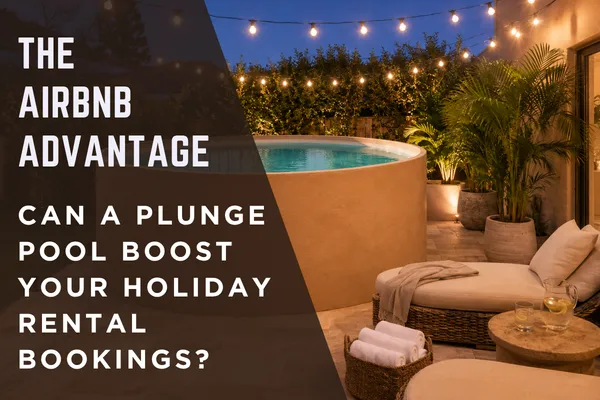
The Airbnb Advantage: Can A Plunge Pool Boost Your Holiday Rental Bookings?
If you manage a short-stay property, you already know the game: guests filter, compare, and click through to the listings that tick their must-have boxes. Pool is consistently reported as one of the most-searched amenity filters on Airbnb worldwide, and search volume for poolside stays spikes hard every year as the warmer months approach. For a host without a pool, that's a lot of search traffic passing straight by.
The catch has always been cost and space. A traditional in-ground pool is a five-figure investment most rental properties can't justify, and it's not something you can take with you if you sell. That's where a plunge pool changes the maths.
The short answer:a plunge pool can add a genuine "has pool" filter match to your listing at a fraction of a traditional pool's cost, without months of construction or a permanent structure you're stuck with. For hosts and property managers weighing up the investment, that combination of low upfront cost, low running cost, and portability makes the ROI case straightforward.
Why Does A Pool Matter So Much To Airbnb Guests?
Guests searching for a getaway increasingly filter by amenity before they even look at photos. Multiple industry sources report pool as the single most-searched filter on the platform, ahead of hot tubs, parking, and air conditioning. Airbnb's own data has shown searches for poolside stays climbing sharply heading into summer, which tracks with what most experienced hosts already notice: listings with "pool" in the amenity list get more clicks, and more clicks mean more bookings.
For Australian hosts, that demand doesn't disappear outside peak summer either. A backyard pool used for cold-water immersion and recovery has year-round appeal, not just a three-month window — which matters if you're trying to keep occupancy steady across shoulder seasons.
How Much More Revenue Can A Pool Actually Add?
The gap between pool and non-pool listings shows up clearly in the data. According to the Professional Holiday Homes 2024 Property Results report, Australian short-stay properties with a pool earned an average of 54% more revenue than those without one. Separately, Australian booking platform Hometime has reported that listings with a pool or hot tub can earn up to 38% more than comparable properties without.
The exact figure moves around depending on location, property type and season, but the pattern doesn't: across every report we could find, pool listings consistently out-earned non-pool listings, sometimes by a wide margin. As a result, even a conservative reading of the data puts a pool amenity well ahead of most other upgrades a host could make to the same budget. For a property that isn't in a naturally pool-heavy market, that gap can be the difference between blending into a crowded search results page and standing out to guests filtering specifically for it.
What Makes A Plunge Pool A Better Fit Than A Traditional Pool?
Three things separate a plunge pool from a full-size backyard pool when you're weighing it up as a rental amenity: cost, space, and portability.
An Aussie Plunge Pool™ is rotomoulded from a single piece of UV-stabilised polyethylene, factory-direct, at a fraction of what a traditional concrete or fibreglass pool costs to build. There's no months-long construction project disrupting a property that's meant to be earning income, and no five-figure loan to justify against nightly rates. Because the shell is lightweight and doesn't require excavation for an above-ground install, most sites go from bare yard to filled pool inside a matter of days rather than months of trades on site.
Portability is the part that's easy to overlook until it matters. If you sell the property, change management arrangements, or move the pool to a different listing entirely, the shell comes with you. That's simply not possible with a poured-concrete pool, which is a sunk cost the moment it's built.
What Does It Actually Cost To Run At A Rental Property?
Running cost is the number every host should have an answer for, because guests and property managers alike want confidence the amenity won't eat into margins. A well-set-up Aussie Plunge Pool™ can cost around $1 a day to run across a full year, covering pump electricity, water treatment, and any heating. Compared to the running cost of a full-size pool, that's a far easier line item to defend to an owner, a strata committee, or your own budget spreadsheet.
Because the shells range from 5,000L to 10,000L rather than the 40,000L-plus of a standard pool, both the pump and chemical dosing stay modest. For a property you're not living in full-time, that also means lower risk of neglected water quality between guest stays — less volume is simply easier to keep on top of.
How Much Time Does Pool Upkeep Take For A Host Or Manager?
Time is often the bigger concern for hosts than money, and here the numbers work in a plunge pool's favour too. A full weekly maintenance routine for an Aussie Plunge Pool™ or Aussie Splash Pool™ takes around 15 minutes: a water test twice a week, a quick skim, emptying the skimmer basket, a light brush of the walls, and a check of the pump timer. Add a monthly filter clean — a two-minute backwash for sand systems, or a hose-down for cartridge systems — and that's the entire program.
For a host or property manager, that routine slots easily into a standard changeover clean between guest stays rather than becoming a separate job. A quick skim and water test before each new arrival keeps the pool guest-ready without adding real time to turnover day, and the seamless polyethylene shell means there's no scrubbing, tiling or grout to worry about between bookings. Compared to the hours a full-sized pool can demand — and the callouts a neglected one can trigger from a guest mid-stay — a 15-minute weekly routine is a manageable addition to almost any host's schedule, whether it's handled personally or folded into an existing cleaning service.
Is A Plunge Pool Big Enough To List As "Has Pool"?
Yes. Airbnb's amenity filter for pool doesn't distinguish by size — it's a yes/no field, and guests filtering by it will see any private pool that meets the listing criteria. A 5,000–10,000L plunge pool, used for a soak, a cool-off, or a cold-water dip after a day of sightseeing, satisfies exactly the search intent behind that filter. It photographs well, it's usable by most guest groups, and it delivers the "private pool" experience guests are searching for without needing lap-swimming space.
Do You Need Council Approval For A Rental Property Pool?
The same rules apply whether the property is owner-occupied or a short-stay rental. In most Australian states and territories, any pool deeper than 300mm needs a compliant safety barrier, registration, and inspection. Aussie Plunge Pools provides engineering documentation and general guidance to support this, but requirements and registration processes vary by state, so it's worth checking your local council or state resource before committing to a purchase or a listing date. Building compliance into the timeline early avoids any surprises before a guest's first booking.
What's The Practical Setup For A Host Or Property Manager?
Most hosts follow the same install path as any homeowner: a level, compacted base pad, confirmed access for delivery, and outdoor power sorted ahead of time. The difference for a rental property is planning around bookings rather than personal use — scheduling delivery and the first fill-and-run cycle in a gap between guest stays keeps the pool ready to list from day one rather than losing a week of availability.
Frequently Asked Questions: Plunge Pools For Holiday Rentals
Does a plunge pool actually increase Airbnb bookings?
A pool is one of the most-searched amenity filters on Airbnb, so listing one can put your property in front of guests actively filtering for it. While results vary by market and listing quality, adding a genuine pool amenity typically improves both search visibility and click-through compared to listings without one.
How much does it cost to run a plunge pool at a rental property?
A well-set-up Aussie Plunge Pool™ costs around $1 a day to run across a full year, covering pump, chemicals and any heating — a modest ongoing cost against the booking appeal it can add.
Can I take the pool with me if I sell the property?
Yes. Aussie Plunge Pools are portable by design. If you sell, change management, or relocate the listing, the shell can be drained, transported, and reinstalled at the new property.
Do I need council approval to add a plunge pool to my rental?
In most states and territories, yes — any pool deeper than 300mm needs a compliant barrier, registration, and inspection, the same as an owner-occupied property. Requirements vary by council, so check your state's resource before committing to a purchase date.
Will guests see a plunge pool as a "real" pool on Airbnb?
Airbnb's pool filter doesn't distinguish by size, so a plunge pool qualifies as a private pool amenity. For guests searching for a soak, a cold plunge, or a spot to cool off, it delivers exactly what they're filtering for.
Thinking about adding a pool to your short-stay property? Come visit our site and check out current plunge pool sizes, shapes and colours. Or call 02) 6628 7948 to discover delivery timelines from Aussie Plunge Pools — Australian family-owned, factory-direct since 1984.
